
The short answer
Choose the complete product configuration for the intended task, not just a nominal wattage, capacity or picture. The catalogue groups kettles into 0.5 L, 1.0 L and 1.7 L. Printed power ranges are category references, not a single rating for each member. Confirm the exact nameplate and plug for the selected model.
Define what the user needs to achieve
Write a brief that includes required water quantity; power supply; vessel material; handling and cleaning. Identify the normal quantity and frequency of use, the environment, who will operate it and what evidence your sales or quality team requires. If the application changes, review suitability again.
Compare catalogue data without mixing versions
Use the model, source page and configuration together. Capacity group, vessel construction and market configuration. Copy units exactly; distinguish nominal vessels from usable fill, carton weights from unit weights, and alternative electrical versions from automatic dual-voltage capability. A comparison table should show what is known and what still needs confirmation.
Which parts does the material claim actually cover?
Start by deciding whether the claim describes the outside housing, the inner vessel or every part inside a defined contact scope. An exterior photo can identify a finish or show where a part sits. Ask for separate evidence to identify the material and establish what it touches in intended use.
Follow filling, heating and pouring
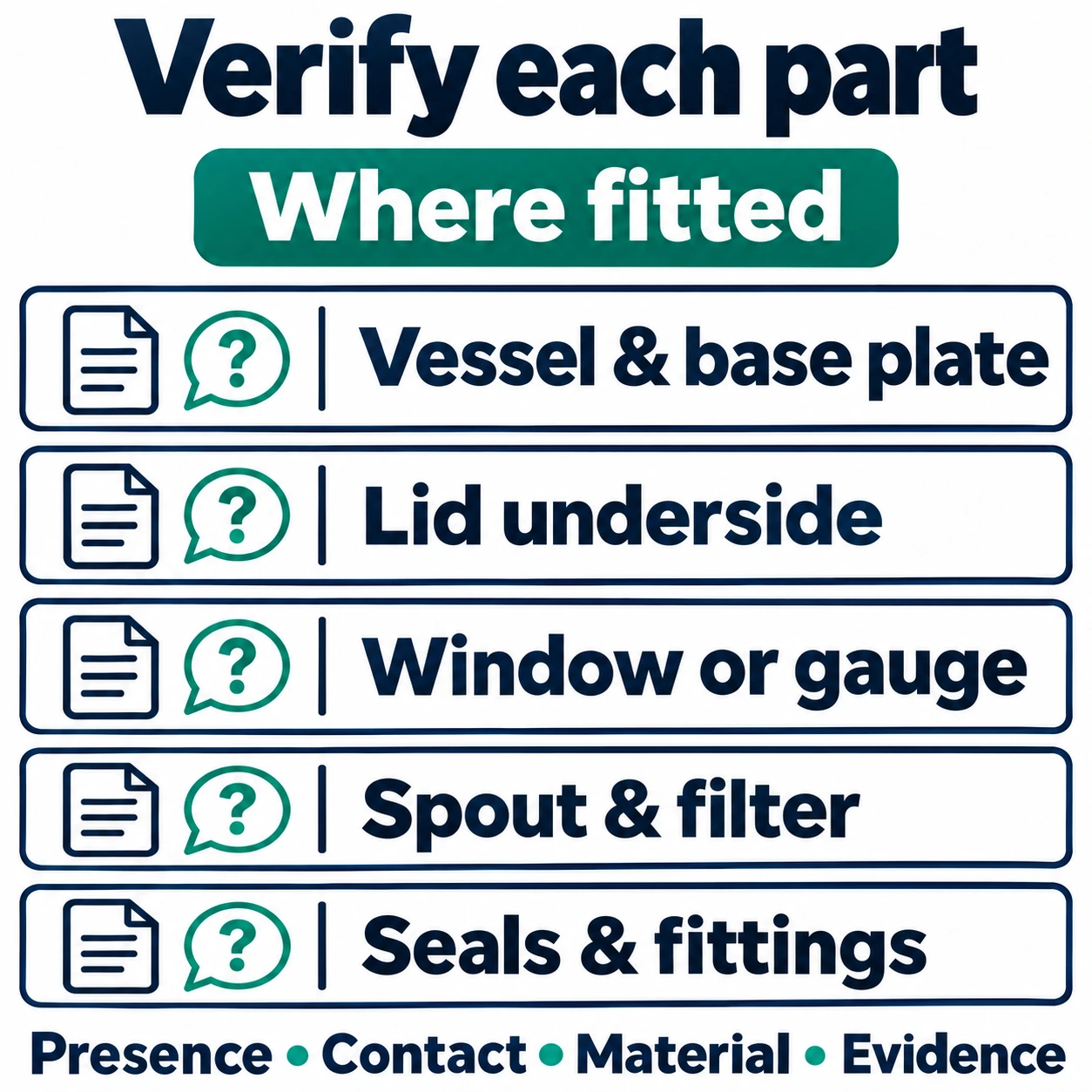
Ask the supplier to mark the parts exposed to water during filling, heating and pouring, and the parts that may contact steam or condensate. Begin with the inner vessel and base plate, then check the lid underside, water window, spout and filter, and any seals or fittings where present. Record water contact, steam or condensate contact, outside the agreed scope, or open. The supplier should explain how it classified any borderline part.
Read each material term at the part level
A stainless steel vessel statement supports wording about the vessel when the model evidence agrees. Check the lid, window, filter frame and seals on their own rows before expanding the wording. For example, Breville’s BKE625 manual identifies a viewing lid, water windows and a removable scale filter as separate parts. The example describes that Breville model and shows why a component list helps. It supplies no material or performance evidence for a HOPING model.
How do you close an open item before approving the sample?
Request a component list or annotated drawing linked to the full model, supplied configuration and revision. For each material statement, record which document describes the part and which report or declaration supports the intended wording, if applicable. Keep appearance observations, written declarations and applicable test evidence in separate columns.
Match the document to the sample and the market version
Record the sample identifier, nameplate and date, and ask which parts were changed if the supplier offers another version. On a representative sample, check visible parts and model labels without dismantling the appliance. Use the current instructions to check which parts the user can remove and how each may be cleaned. A photo or visual review cannot identify a material grade or verify a test result.
Resolve the claim and the purchase requirement separately
Mark an item confirmed only within the scope its evidence supports. If the supplier confirms the vessel but leaves the lid or seal unanswered, use vessel-specific wording if appropriate and keep the other parts open. If a material on an open row is a buying requirement, obtain the missing evidence or evaluate another configuration before approving the order. Specify temperature control, indicators or sound requirements independently and request evidence if any is essential.
- Review model documentation
Match the evidence to the exact model and document revision.
Review the supplied set and channel
Agree the accessories, parts, colors and packaging in an itemized offer. Retail and e-commerce programs may need different artwork, manuals, inserts or shipping protection. A product photo cannot determine everything supplied with an order. Ask which changes can use the existing platform and which require separate development.
Approve a representative sample and documents
Check that the sample is the selected configuration. Record the relevant performance or fit criteria, how they will be inspected, the manual revision and the report/certificate scope. If you require a particular test, agree its method, sample version, responsibility and acceptance criteria before ordering.
Turn the comparison into a useful enquiry
Send a shortlist of full model references with the application, market, quantity, electrical version, accessory set, customization, document needs and schedule. Ask HOPING to separate confirmed items, available alternatives and points requiring review. This makes quotations comparable and keeps engineering, quality and purchasing aligned. Include any material requirement by part, your intended consumer-facing wording, and the rows still open in the review. Ask for document references and the sample revision in the quotation.
- Discuss your kettle configuration
Include the full model, destination and material evidence you need.
Model-specific kettle specifications and packing
The supplied kettle specification sheet adds model-specific capacity, power, electrical and carton information for HD-04, HD-08, WK-29, WK-21, WK-22, WK-1002, WK-58, WK-78, HD-16, HD-17 and HD-13. HOPING confirms the HD-03A/15A sheet parameters also apply to HD-03, the HD-10/10A parameters to HD-11/HD-11A, and the HD-02A parameters to HD-02/HD-02A. HOPING confirms 202 stainless steel heating plates for HD-16 and HD-17. Use these individual entries when available rather than assigning a catalogue family power range to every model. Blank fields have no confirmed value. Market voltage alternatives identify separate supplied versions. Heating plate or tube material does not identify the vessel material. Packaging dimensions and carton weights do not establish individual appliance dimensions or weight.
| Step | Compare | Required next action |
|---|---|---|
| Intended task | required water quantity; power supply; vessel material; handling and cleaning | Define the recipe/object and expected result before selecting a model |
| Configuration | Capacity group, vessel construction and market configuration | Record each option in the specification and approved sample |
| Evidence | Nameplate, specification, operating instructions and applicable reports | Match full model and market version; record the document date |
| Channel | Retail, distribution, e-commerce or private label | Confirm packaging, artwork, language and after-sales information |
| Model | Nominal capacity | Rated power | Units per carton |
|---|---|---|---|
| HD-02 / HD-02A | 0.5 L | 920–1100 W | 12 |
| HD-03 | 0.5 L | 920–1100 W | 12 |
| HD-04 | 1.7 L | 1850–2200 W | 12 |
| HD-08 | 1.0 L | 920–1100 W | 12 |
| WK-29 | 1.0 L | 1200 W | 12 |
| WK-21 | 1.7 L | 1850–2200 W | 8 |
| WK-22 | 1.7 L | 1850–2200 W | 8 |
| WK-1002 | 1.0 L | 760–900 W | 8 |
| HD-11 / HD-11A | 0.5 L | 920–1100 W | 12 |
| WK-58 | 1.0 L | 850 W | 8 |
| WK-78 | 1.7 L | 2000 W | 8 |
| HD-16 | 1.7 L | 1850–2200 W | 8 |
| HD-17 | 1.0 L | 920–1100 W | 8 |
| HD-13 | 1.7 L | 1850–2200 W | 8 |
| Part, where fitted | What to record | Evidence to request |
|---|---|---|
| Inner vessel and base plate | Separate identities and surfaces in the water path | Annotated drawing and part-level material record |
| Lid underside and its fittings | Which surfaces contact water, steam or condensate | Lid assembly description for the selected revision |
| Water window or gauge | Wetted faces and any fitted seal | Drawing or component scope for the exact version |
| Spout and filter assembly | Material for each relevant part and permitted removal | Supplied parts list and operating instructions |
| Other seals and fittings | Location, contact scope and unknowns | Supplier confirmation supported by applicable model documents |
| Exterior housing | Scope of appearance wording and whether separate from vessel | Approved finish reference and part specification |
What capacity and rated power options are available for electric kettles?
The catalogue groups kettles into 0.5 L, 1.0 L and 1.7 L. Their printed group power references are 920–1100 W, 760–1200 W and 1850–2200 W respectively. Confirm the exact member model and nameplate before selecting one rating.
Which plug and voltage variants can be supplied for different countries?
Specify the destination country, mains voltage/frequency, required plug and cord arrangement. The source package does not confirm every plug for every kettle. Obtain the selected electrical version and applicable supporting documents.
Does each kettle include automatic shut-off and boil-dry protection?
The current source package does not contain a model-by-model verified shut-off and boil-dry test matrix. Request the actual controller configuration, operating instructions and relevant test results before using these features as a claim.
Which water-contact materials are used and documented?
Request the full model and revision, an annotated component list and the applicable evidence for each claim. A stainless steel exterior or vessel description does not identify the lid, gauge, filter or seals. Mark any unresolved row as open and keep it out of broader material wording.
What is the confirmed specification of model WK-1002?
WK-1002 appears in the current catalogue’s 1.0 L group. The group power reference is 760–1200 W, rather than one confirmed individual rating. Confirm its nameplate, vessel, plug, supplied parts and current manual for the intended order.
What should a UK buyer verify before sourcing a 0.5L travel kettle?
Start with the complete current 0.5 L kettle reference and confirm the exact electrical version, plug, vessel, fill, handling, instructions and market documents. The catalogue capacity group is not evidence of outdoor, vehicle, camping or automatic dual-voltage suitability.
Sources
- HOPING WK-1002 — capacity, electrical-version and packing fields
- Breville BKE625 instruction booklet, Components and Care & Cleaning (external model example)
Models covered by this guide
Check the current configuration, source and enquiry requirements on the individual model page.
Browse all 15 models covered by this guide
- WK-1002 · Electric Kettle
- WK-21 · Electric Kettle
- WK-78 · Electric Kettle
- WK-58 · Electric Kettle
- WK-29 · Electric Kettle
- WK-22 · Electric Kettle
- HD-09 · Electric Kettle
- HD-08 · Electric Kettle
- HD-04 · Electric Kettle
- HD-13 · Electric Kettle
- HD-03 · Electric Kettle
- HD-11 / HD-11A · Electric Kettle
- HD-02 / HD-02A · Electric Kettle
- HD-17 · Electric Kettle
- HD-16 · Electric Kettle