
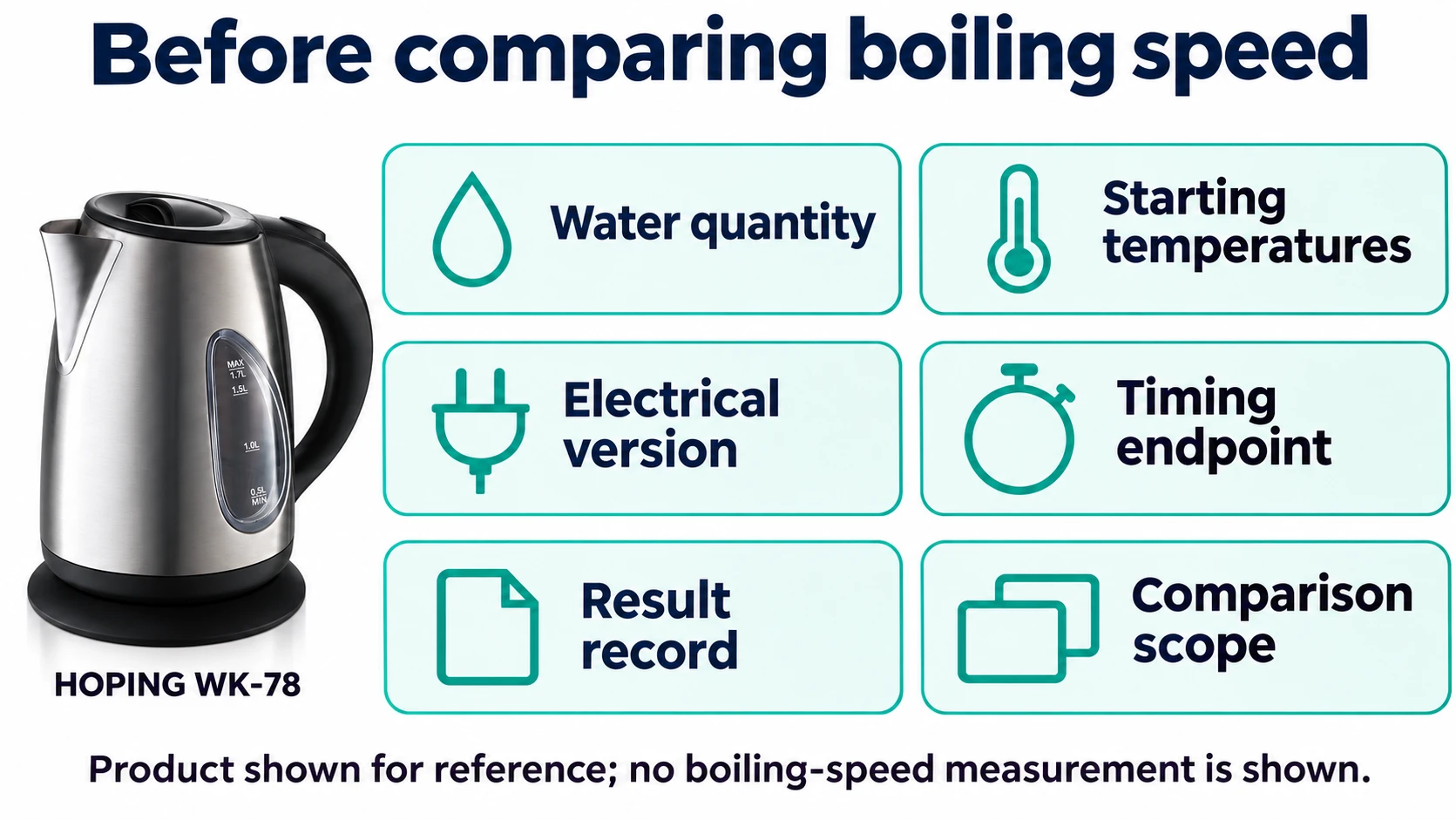
Check the test conditions before ranking two kettles by seconds. A useful comparison identifies the amount of water, its starting temperature, the appliance’s electrical version, the timing endpoint and the evidence behind any comparative wording. If these differ or are missing, ask for clarification before using the figures to select a supplier or approve retail artwork.
What does the published result actually cover?
Tiger’s PCZ-A080 announcement, dated 8 September 2026, illustrates why footnotes matter. Its one-cup measurement uses approximately 140 mL, with water and room temperature at 23°C and operation at rated power consumption. Its comparison statement is limited to publicly available information on household kettles sold in Japan, using in-house research as of that date. The specification lists a 100 V version. These are conditions for Tiger’s stated result, not a HOPING test or a UK or European performance guarantee.
Treat this as a historical example of a scoped claim, checked on 17 November 2026. It is not news of a new event today. Read the qualification beside a speed statement before copying it into a buying comparison; a headline alone can omit the limits that make the number meaningful.
Separate a measured time from a market-ranking claim. The first describes an observation under stated conditions. The second also needs a defined comparison group and date. A result for one specified quantity does not establish the time for every permitted fill, and an older comparison does not establish today’s market position.
Which conditions belong in a comparable evidence request?
Use the checklist below to request the same fields from each shortlisted supplier. Keep both the stated result and its conditions in the buying record. When a field is missing, write “not supplied” rather than filling the gap from another model, a photograph or a category-level wattage range.
Agree what starts and stops the timer. For example, a procedure ending at automatic switch-off should not silently be compared with one ending at an observed temperature. Ask how the endpoint was detected and how the result was recorded. This is a request to define the method, not an instruction to bypass any control or operate outside the manual.
Distinguish a cold start from a repeat run with a warm appliance. Ask whether the reported figure is a single observation, an average or another stated summary, and request the associated readings when available. Without a matched method, avoid interpreting a small difference in reported seconds as proof of a better product.
How should the evidence change the sourcing decision?
First decide whether speed is a necessary requirement for your intended use or simply a marketing preference. Put the required quantity and use scenario in the brief, then ask suppliers which selected versions can be evaluated against it. A fast result from a different electrical configuration does not answer that procurement question.
If the existing evidence is not comparable, request a documented evaluation using an agreed method for the shortlisted versions. Purchasing, product and quality teams should agree responsibility, sample identity and acceptance criteria before ordering that work. This guide supplies no universal test standard, pass limit or HOPING measurement.
Before approving a speed statement, check that its wording preserves the supported conditions and scope. Keep the evidence reference with the artwork revision; reopening a claim may be necessary when the supplied configuration changes. Avoid replacing a limited observation with an unrestricted “fastest” claim.
For a HOPING enquiry, send the complete kettle model, destination market, intended water quantity, electrical requirements and the speed wording you would like to evaluate. Ask which documents are available for that version and what remains to be reviewed. A request for evidence does not imply that a particular result has already been achieved.
- Select the kettle configuration first
Use the existing guide for capacity and configuration selection.
- Prepare the model document request
Match evidence to the selected version.
- Discuss your kettle buying brief
Include the intended use and claim you need evaluated.
| Field | Ask the supplier to state | Decision use |
|---|---|---|
| Water quantity | Measured quantity and units | Match the intended task |
| Initial conditions | Water and room temperatures; cold or warm start | Identify differing starting conditions |
| Electrical version | Full model, voltage, frequency and rated power | Keep supplied versions distinct |
| Timing endpoint | Start trigger, stop trigger and detection method | Avoid comparing unlike endpoints |
| Result record | Readings, repetitions and reported summary | See what the stated figure represents |
| Comparison scope | Products, market, source set and reference date | Keep ranking wording within its evidence |
Can an import team calculate the missing boiling time from wattage alone?
Use the electrical rating to identify the configuration, not to fill a missing measured-time field. Request a documented result under the proposed conditions. A calculation without a validated method does not establish the performance statement for the supplied kettle.