
Select a food chopper by its configuration and permitted task, then compare the complete workflow from preparation to cleaning and storage. Chopping time alone does not establish overall convenience.
The short answer
Choose the complete product configuration for the intended task, not just a nominal wattage, capacity or picture. Compare the 500 ml AS-bowl group, 2 L glass-bowl group, 3 L stainless-steel HFP-905B S/S and 1.2 L HFP-904B separately. A larger nominal bowl does not state maximum usable fill or permitted ingredients.
Define what the user needs to achieve
Write a brief that includes ingredients and desired texture; intended working fill; cleaning procedure. Identify the normal quantity and frequency of use, the environment, who will operate it and what evidence your sales or quality team requires. If the application changes, review suitability again.
Compare catalogue data without mixing versions
Use the model, source page and configuration together. Bowl material, nominal capacity and blade configuration. Copy units exactly; distinguish nominal vessels from usable fill, carton weights from unit weights, and alternative electrical versions from automatic dual-voltage capability. A comparison table should show what is known and what still needs confirmation.
Review the supplied set and channel
Agree the accessories, parts, colors and packaging in an itemized offer. Retail and e-commerce programs may need different artwork, manuals, inserts or shipping protection. A product photo cannot determine everything supplied with an order. Ask which changes can use the existing platform and which require separate development.
Does the complete task justify a food chopper?
Compare the finished task rather than the motor-on interval. For an importer, the useful question is whether the selected configuration fits the quantity, preparation routine and cleanup expectations of the intended customer. A short chopping demonstration can omit work that the customer still has to do.
Define a comparable preparation task
Specify the ingredient, starting condition, quantity and desired result before comparing samples. Record whether washing, trimming or cutting ingredients into permitted pieces is included in the observation. If two demonstrations start from differently prepared ingredients, their recorded times answer different questions. Use only ingredients and quantities permitted by the selected model instructions.
A comparison with a knife or another appliance is useful only when the intended output is sufficiently similar. A rough cut and a fine texture are different tasks. Do not describe a manual tool, a large processor and a small electric chopper as interchangeable merely because all reduce the size of food. State the task each sample is being asked to complete.
Separate active work from elapsed time
Record preparation, assembly, loading, permitted operation, unloading, cleaning and storage separately. Mark the start and end of each stage. Keep hands-on work distinct from waiting: a drying interval may add elapsed time without requiring the operator to remain at the work surface. If stages overlap, record that overlap rather than adding the same minutes twice.
Do not extrapolate a single small-batch observation into a claim that the machine always saves time. The result belongs to the recorded task and configuration. If the customer normally prepares a different amount or expects several preparations in succession, evaluate that situation separately within the documented operating limits.
How should cleanup and storage enter sample approval?
Include the parts actually supplied with the order in the review. The shape of the bowl, the blade assembly and the lid may matter to the workflow, but a picture or material label does not establish a permitted cleaning method.
Map the cleaning instruction to each component
Make a component list for the selected model and connect each item to the applicable manual section. Record whether removal is part of normal user handling and which cleaning instructions the manufacturer provides. Do not infer dishwasher permission, immersion permission or an allowable cleaning chemical from glass, stainless steel or a removable appearance.
If the instructions do not resolve a component question, leave that field unresolved and request the applicable document. A missing instruction is not permission to improvise a procedure. The sample review should follow the approved instructions; it should not become an unofficial dismantling or cleaning experiment.
Record the practical observations and the next decision
Use the buyer’s agreed criteria to record access for permitted cleaning, visible residue after the prescribed procedure, reassembly and the space required for storage. Keep these observations separate from a hygiene certification or a durability claim. A demonstration of one permitted routine does not establish every possible use or cleaning condition.
Keep photographs or video, the sample reference, the manual revision and any deviations with the review. If a result is unsatisfactory, identify the stage and observation before attributing a cause. The next action might be a clarification of instructions, a different approved configuration or a further documented evaluation. Do not replace an unresolved observation with an unsupported promise that another bowl material will solve it.
Approve a representative sample and documents
Check that the sample is the selected configuration. Record the relevant performance or fit criteria, how they will be inspected, the manual revision and the report/certificate scope. If you require a particular test, agree its method, sample version, responsibility and acceptance criteria before ordering.
What should you verify before ordering a replacement blade assembly?
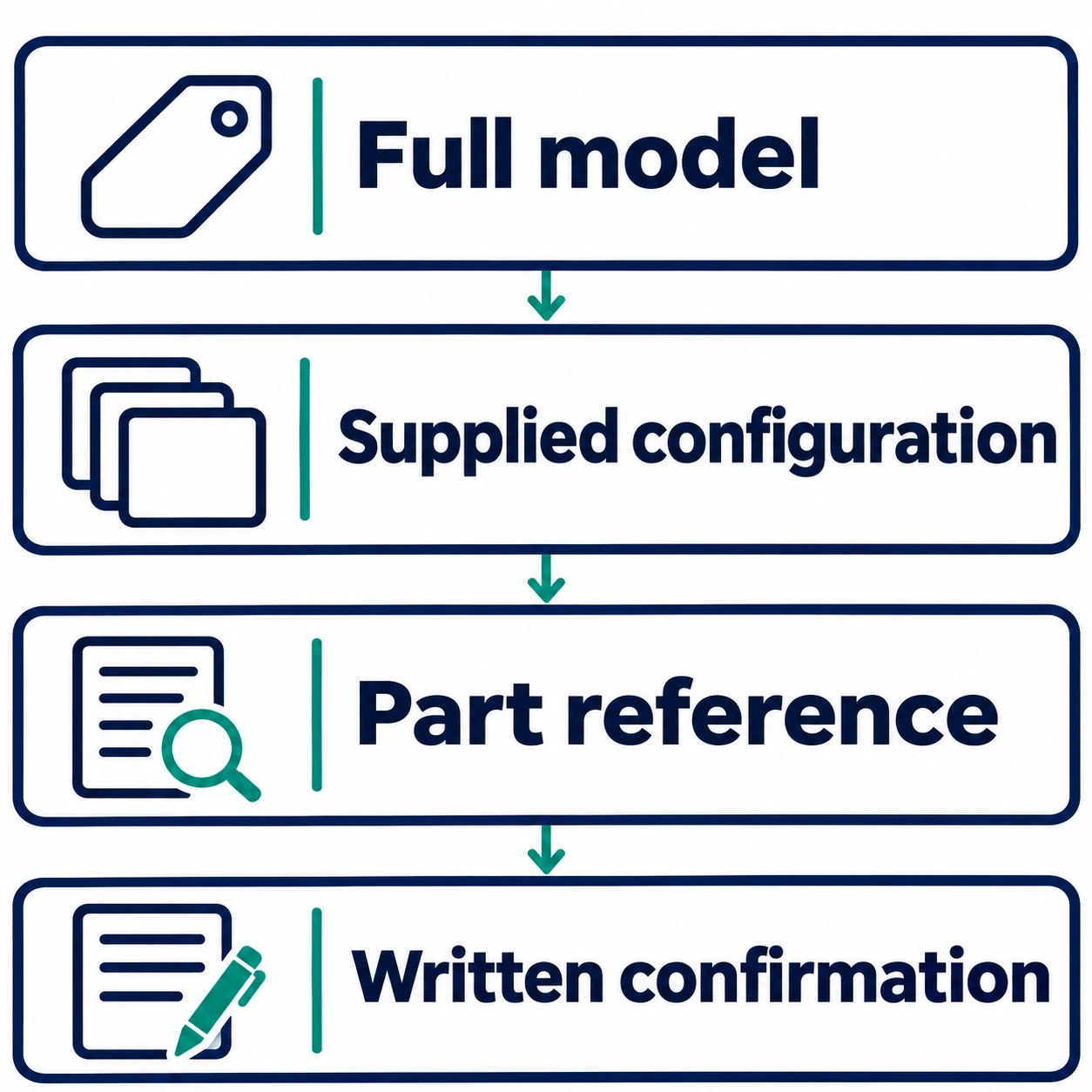
Ask the supplier to confirm in writing that the offered assembly is approved for the full appliance model and the configuration already in service. Record which machine and part revisions the confirmation covers. If the supplier cannot identify the original part or the appliance configuration, keep the order line open until it can confirm the match.
Identify the appliance and its supplied set
Collect the exact model and suffix from the appliance label, together with the order or lot reference when available. Add the bowl and lid configuration supplied with that order. Use the original purchase record or approved sample record when a retail name identifies several configurations. Ask the service team for existing label photos or documents without requiring a consumer to dismantle the appliance.
Match the offered part and its revision
Request the replacement assembly’s full part number, document revision and the applicable model and configuration list. If the supplier proposes a successor part, ask it to identify the old reference being replaced and any limits on the substitution. Treat a missing part mark as an open question and route it to the supplier with the available order and sample records. Appearance, nominal bowl size and an apparent fit do not establish an approved match.
Use the historical example to understand evidence scope
In a Cuisinart food processor recall dated 13 December 2016, the U.S. Consumer Product Safety Commission defined scope using both model prefixes and a four-rivet blade design. This was a Cuisinart case. It illustrates why a part description and machine identifier may both matter when an official document defines scope. It provides no compatibility determination for HOPING parts.
Keep the written confirmation with the order
Record the supplier’s named confirmation, date, document reference, exact appliance and part identifiers, supported configuration, and any exceptions. For a mixed service order, give each machine-and-part combination its own line. When the proposed part or supplied configuration changes, ask for a fresh confirmation before reusing the old purchase reference. Follow current model instructions and the approved service channel if handling or repair is required.
- Check the model and document revision
Keep the appliance and replacement part evidence together.
- Request a model-specific parts check
Provide the full model, order reference, supplied configuration and known part marking.
Turn the comparison into a useful enquiry
Send a shortlist of full model references with the application, market, quantity, electrical version, accessory set, customization, document needs and schedule. Ask HOPING to separate confirmed items, available alternatives and points requiring review. This makes quotations comparable and keeps engineering, quality and purchasing aligned.
| Step | Compare | Required next action |
|---|---|---|
| Intended task | ingredients and desired texture; intended working fill; cleaning procedure | Define the recipe/object and expected result before selecting a model |
| Configuration | Bowl material, nominal capacity and blade configuration | Record each option in the specification and approved sample |
| Evidence | Nameplate, specification, operating instructions and applicable reports | Match full model and market version; record the document date |
| Channel | Retail, distribution, e-commerce or private label | Confirm packaging, artwork, language and after-sales information |
| Stage | Record | Buying decision |
|---|---|---|
| Task baseline | Ingredient preparation, permitted amount and intended texture | Are the samples doing the same task? |
| Assembly and operation | Sample identity, allowed settings and operating limits | Does the demonstrated version match the offer? |
| Unloading and cleaning | Component list, manual reference and actual observations | Can the intended routine be assessed from the supplied instructions? |
| Drying and storage | Active work, elapsed time, overlap and storage arrangement | What effort remains after chopping? |
| Unresolved item | Missing evidence, owner and agreed next action | What must be resolved before approval? |
| Check | Record or request | If missing |
|---|---|---|
| Appliance identity | Full nameplate model and suffix, order or lot reference | Get an order or label record before assigning a part |
| Supplied configuration | Actual bowl, lid and assembly configuration | Ask the supplier to identify the configuration |
| Replacement reference | Part number, revision and any replacement mapping | Keep the proposed substitute pending |
| Written confirmation | Applicable model and version, exceptions, issuer and date | Do not release the parts order line |
What bowl capacities are available for your electric food choppers?
The current catalogue includes 500 ml AS-bowl models, a 2 L glass-bowl group, HFP-904B at 1.2 L and HFP-905B S/S at 3 L. Nominal vessel capacity is not maximum working fill. The unlabelled 700 ml reference needs model identification before it can become a separate orderable SKU.
Which bowl materials are offered and what are their trade-offs?
Compare AS, glass and stainless-steel bowl configurations as separate model choices. Confirm contact material, handling, cleaning and packaging requirements from the exact model documents. Do not infer dishwasher compatibility, impact resistance or permitted temperatures solely from the material name.
Can a 2-liter glass bowl food chopper be customized for a private-label brand?
The catalogue has a 2 L glass-bowl family, and the company offers evaluation of logo, color, appearance, structure and function changes. Specify the full model, desired change, quantity and market; customization scope, tooling and testing require project confirmation.
What is the confirmed rated power and voltage of each food chopper model?
Each model page preserves the readable catalogue power and electrical references with its PDF page. Some values describe a family range or alternative market versions. Ask for the selected model nameplate and approved specification before using a single rating in artwork or a purchase order.
What blade material, blade count, and assembly options are available?
The readable food-chopper group descriptions list two pairs of 420 stainless-steel blades and ABS housing. Confirm the full blade assembly and supplied configuration for the exact model. The source does not establish interchangeable blades across the range.
What safety interlocks and overheating protections are used?
Model-specific safety-interlock architecture and verified protection-test results have not been supplied for all choppers. Request the manual, selected configuration and relevant test evidence before making a safety-feature claim.
How do the HFP-901 and HFP-902 configurations differ?
HFP-901 and HFP-902 are separate current catalogue references within the 500 ml AS-bowl group; their B variants belong to the 2 L glass group. Shared group ratings do not prove identical construction. Compare source images and obtain the selected configurations before claiming a functional difference.
What food processing tasks have been tested for each model?
The supplied catalogue identifies food-chopping appliances, but it does not contain a complete ingredient-by-model validation matrix. Define ingredients, quantity and desired texture, then request the manual or a documented sample test. Do not assume hard-food, ice, hot-liquid or continuous-use capability.
What is the maximum continuous operating time and recovery procedure?
A verified maximum run time and recovery cycle has not been supplied for every chopper. Obtain the operating instructions for the exact model and configuration; rated wattage and nominal bowl capacity cannot determine the duty cycle.
Which replacement bowls, blades, and lids can be ordered separately?
The company offers to evaluate spare parts according to product structure and after-sales needs. Request an itemized model-specific bowl, lid and blade list with quantity, price and supply terms. No universal interchangeability or standing stock is promised. For a blade assembly, ask the supplier to record the full appliance model and configuration, the exact replacement part number and any revision limits. Keep the confirmation with the service order.
How does nominal bowl capacity differ from recommended maximum fill on a food chopper?
Nominal capacity describes the vessel or catalogue reference. Maximum working fill depends on the actual model, ingredient and operating instructions and may be lower. The catalogue does not supply a complete verified working-fill matrix; obtain the manual or a documented sample test.
Glass bowl vs plastic bowl food chopper: what should a private-label buyer compare?
Compare the actual AS, glass or stainless-steel model configuration, nominal vessel size, handling/cleaning instructions, contact-material evidence and shipping pack. A material label alone does not establish breakage performance or dishwasher compatibility.
Should unattended drying time be added to hands-on preparation time?
Keep the two measures separate. Record elapsed drying time where it matters to the intended routine, and identify any overlap with other work. Combining them without explanation can obscure the comparison.
Can a cleanup demonstration prove long-term durability?
No. A recorded cleaning routine describes the observed sample and conditions. A long-term durability statement needs its own applicable evidence; it does not follow from one demonstration.
Sources
Models covered by this guide
Check the current configuration, source and enquiry requirements on the individual model page.
Browse all 20 models covered by this guide
- HFP-501B · Food Chopper
- HFP-901B · Food Chopper
- HFP-905B · Food Chopper
- HFP-601 · Food Chopper
- HFP-701 · Food Chopper
- HFP-801 · Food Chopper
- HFP-901 · Food Chopper
- HFP-902 · Food Chopper
- HFP-903 · Food Chopper
- HFP-501 · Food Chopper
- HFP-905 · Food Chopper
- HFP-601B · Food Chopper
- HFP-701B · Food Chopper
- HFP-801B · Food Chopper
- HFP-902B · Food Chopper
- HFP-903B · Food Chopper
- HFP-905B S/S · Food Chopper
- HFP-904B · Food Chopper
- HFP-907 · Food Chopper
- HFP-908 · Food Chopper