
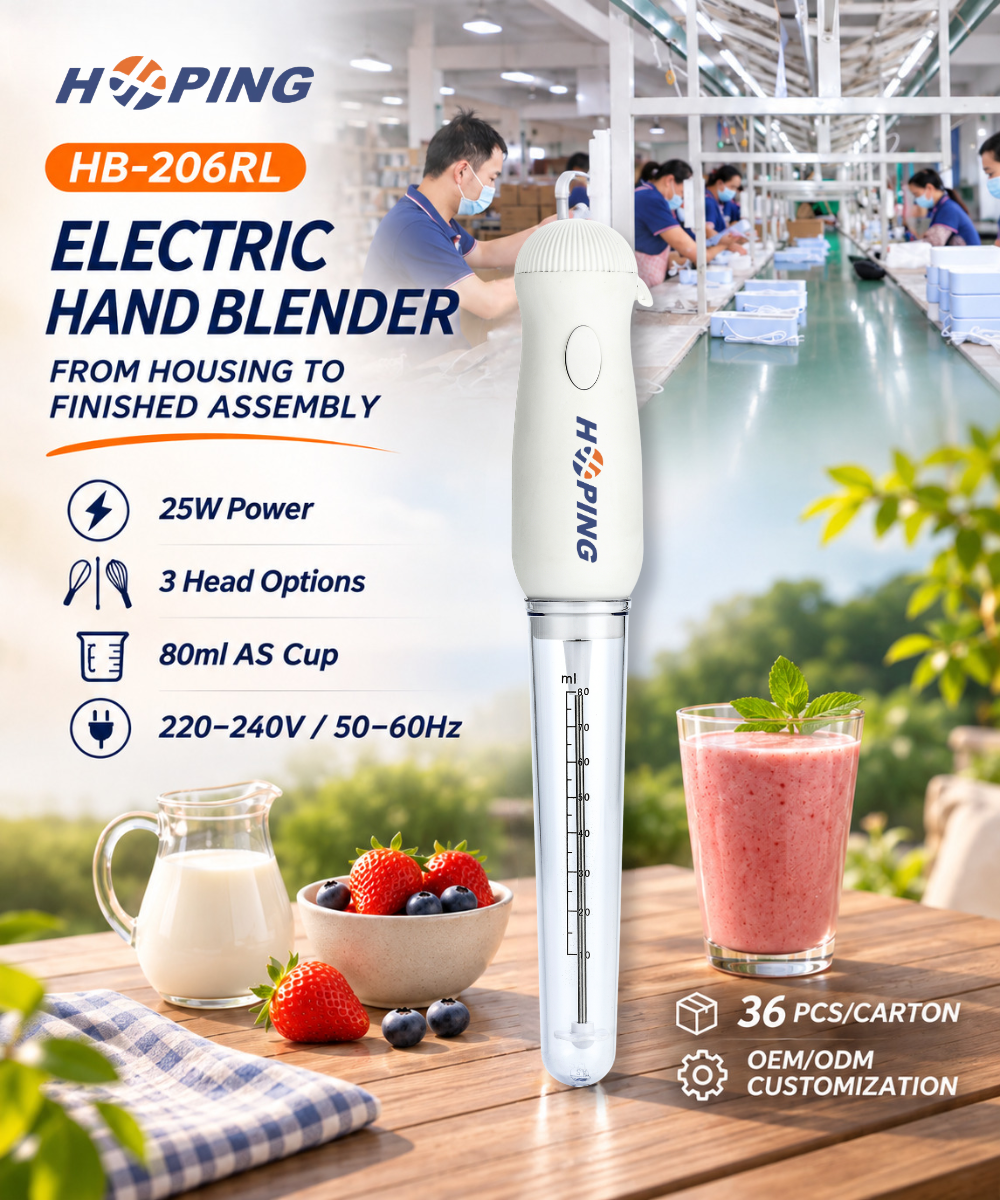
Importers and private-label brands can check consistency by approving an identifiable HB-206RL sample and documenting what should match it from the ABS housing through final assembly and packing. Match the exact parts, supply version and retail pack to the written offer. A factory image provides context. The sample, specifications and agreed inspection record provide the evidence for the proposed order.
What configuration are you approving?
HB-206RL is listed as a 25 W handheld beverage mixer. The catalogue reference lists a stainless-steel stick, flat, plastic and spring head options, and an 80 ml AS measuring cup. Confirm the head, cup and other items included in your offer.
Keep the reference sample tied to the order
Save the full model suffix, sample identifier, revision and itemised supplied set together. Photograph the approved housing finish and the supplied head for reference. Identify any features that still need functional review. If a sales sample differs from the intended order, record which items it represents and request a sample covering the remaining items.
Use the intended task to set the review
Describe the beverage or light mixing task, working amount, vessel and expected use pattern. The nominal cup marking and the rated power leave working limits and ingredient suitability to the applicable manual or an agreed demonstration. The illustrative drink in the LinkedIn graphic does not establish that the mixer can process whole fruit or ice.
- HOPING 2026 catalogue, PDF page 11
Check the catalogue against the exact offered configuration.
What should you check on the ABS housing?
Translate the approved appearance into observable criteria that purchasing and quality can share. Define which surfaces are visible in use and which areas carry branding or engage other parts.
Specify appearance against an agreed reference
Record the approved colour and finish, logo position and the viewing conditions for the sample review. Where a seam, mark or surface difference matters, describe its location and agree how to judge it. A photograph can identify the area of concern. Retain the physical reference where colour or finish is critical.
Ask how a housing change is reviewed
If the finish, logo process or housing revision changes, identify the affected area and ask which checks should be repeated. A cosmetic revision can be reviewed separately from a change that affects fit, controls or assembly. Agree the evidence before releasing the changed specification.
What should the final assembly review cover?
Ask the supplier to show the ordered head, stick, housing and control together on the representative sample. Compare what is physically present with the specification and the itemised quote.
Check the parts as a supplied set
Ask for the agreed method for checking the supplied head, assembly fit and control response. Record who performs the checks and what constitutes an acceptable result. Similar-looking heads may differ by configuration, so check the order reference before assuming that an accessory from another model fits.
Keep a functional observation with its conditions
Where a demonstration is useful, document the permitted ingredients, working amount, vessel, selected head and observed outcome. Confirm the relevant operating and cleaning instructions first. If the intended task or use pattern falls outside the evidence, record it as an open question in the approval sheet.
Which electrical version is relevant to an Americas order?
Specify the destination country and the required electrical supply before approving the sample or packaging. The LinkedIn graphic shows the 220–240 V, 50–60 Hz configuration. The catalogue separately lists a 110–120 V, 60 Hz alternative for review.
Match nameplate, sample and paperwork
Request confirmation of the actual voltage, frequency, plug and exact configuration offered for the destination. Check that the sample label, quote, manual and supporting documents refer to the same version. Treat alternative listings as separate configurations and confirm current availability for the project.
How do you carry the approved sample into packing and repeat orders?
The catalogue lists 36 units per carton. Treat this as a reference when you confirm the supplied set, packaging revision and final carton count for the order.
Check markings and pack contents together
Compare the unit, supplied accessories, artwork, barcode, manual and carton marking against the same approved revision. If the sample used temporary artwork or an incomplete accessory set, identify the remaining checks before it is used as a production reference.
Keep production changes visible
Agree which records the supplier will provide for the order and how the teams will handle substitutions. For a repeat order, refer back to the approved sample and confirm whether the housing, head, supply version or packaging has changed. This gives quality and purchasing a shared way to resolve a difference before shipment.
What should you send with an HB-206RL enquiry?
Send the full model reference, destination country, intended mixing task, required electrical version, desired head and cup, order quantity, brand artwork and packaging requirements. Ask HOPING to identify the supplied set, sample scope, relevant model documents, and the checks that can be agreed for the proposed order.
- View the HB-206RL model and enquire
Confirm the configuration and project requirements for your destination.
- Review sample and production consistency
Use the approval record to connect sample observations to order checks.
| Checkpoint | Evidence to request | Decision before approval |
|---|---|---|
| Housing and branding | Approved sample, finish reference and logo artwork | Agree which surfaces and markings must match. |
| Final assembly | Supplied head, stick, controls and agreed functional check | Resolve any mismatch between the sample and the offered set. |
| Electrical configuration | Nameplate record, plug and matching product documents | Confirm the configuration for the destination country. |
| Packaging | Approved pack and manual revisions, accessory list and carton count | Confirm what will ship with each unit. |
| Repeat order | Recorded revision and any proposed changes | Agree which checks to repeat before release. |
Should the three head options be listed as included accessories?
Ask HOPING to identify the supplied head or heads in the quote and on the approved pack list. The catalogue identifies options and the itemised offer defines what is included.
Can one approved sample cover two electrical versions?
Confirm how each version is represented. Appearance may be reviewed on a shared reference where appropriate. The nameplate, plug, operating configuration and applicable documents still need to be checked for the version ordered.
What if the sales sample has a different logo or pack from the intended order?
Record what that sample represents and keep the unapproved items open. Review the actual artwork, pack and any relevant changed surfaces or contents against the final configuration.
Models covered by this guide
Check the current configuration, source and enquiry requirements on the individual model page.