
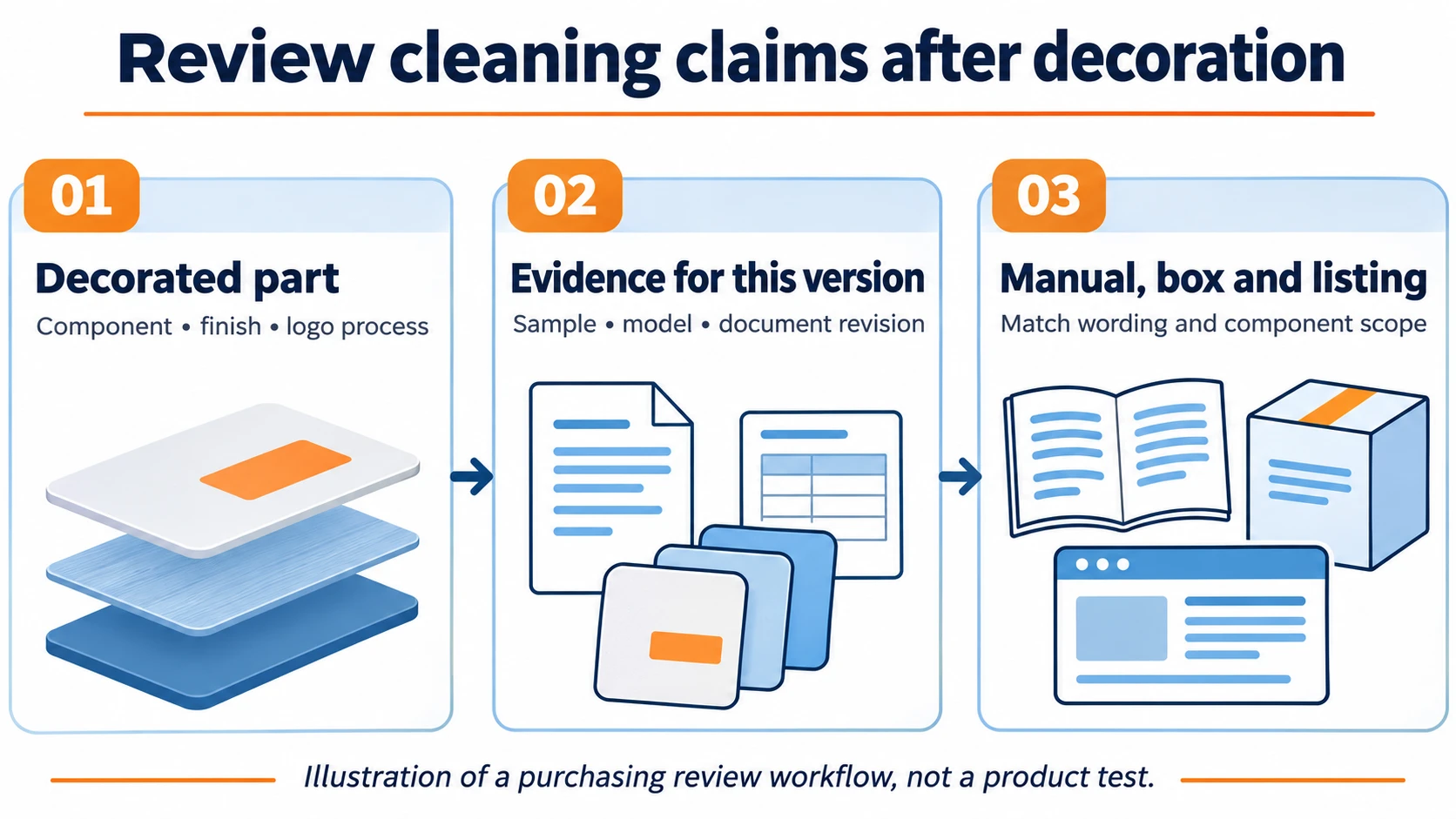
Yes—review the claim before carrying it over to the branded version. Adding a logo does not automatically make an appliance unsuitable for a particular cleaning method, but the standard version’s instructions do not by themselves establish what is suitable for a changed coating, print or engraving. For a private-label order, resolve that question before approving the retail box and online listing.
Which cleaning claim needs a fresh check?
Start with the part that has changed. Is the logo applied to a removable container, its lid, a housing or a powered base? Record the decoration method and any change to the finish. A statement about one part should identify that part; “dishwasher safe” beside a photograph of the entire set can leave the customer unsure what the instruction covers.
Ember provides a specific example. Its Mug 3 FAQ distinguishes standard mugs, which it permits in the dishwasher’s top rack, from customized or branded mugs, which it instructs users to hand wash to protect the finish and decoration. It separately excludes the charging coaster from dishwashing and immersion. This is an Ember instruction for the products described in that FAQ, checked on 17 November 2026. It establishes no cleaning permission or restriction for a HOPING appliance.
The purchasing lesson is to ask whether the proposed instruction covers the decorated component and the supplied set. Do not conclude that every printed logo requires hand washing, or that engraving always preserves an existing cleaning claim. Obtain the answer for the actual configuration.
What evidence should purchasing request for the decorated version?
Ask the supplier to identify the decorated sample and the cleaning instruction proposed for it. If an existing report is offered, ask which finish, decoration process and component it covers. A report for an undecorated container leaves a question to resolve when the order changes that surface; it is not evidence that the new version has failed.
Record the exact model and suffix, sample reference, document revision and owner of the approval decision together. If further testing is proposed, agree the cleaning method, cycle conditions, inspection criteria and responsibility before treating the result as support for the claim. This article does not prescribe a universal dishwasher test or acceptance threshold.
HOPING’s project review starts with the requested customization and selected model. Ask for confirmation of the decoration process, applicable instructions and any additional evaluation needed. Logo customization availability is not a blanket promise that every decorated version supports the standard cleaning method.
- Review branding options for your project
Identify the requested decoration and finish changes.
- Review model documentation
Match the proposed instructions to the supplied version.
How should the instruction reach the box and online listing?
Give the approved cleaning statement an identifiable revision and carry its component scope into each customer-facing location. Check the manual, package care panel, retailer description, product photographs with care symbols, and any quick-start insert. An updated manual does not resolve an old dishwasher icon still visible in a listing image.
Use a short change record: previous statement; affected component; decorated sample reference; supporting document; replacement wording; channels to update; approval owner. If existing undecorated stock remains on sale, keep the two versions distinguishable rather than silently applying one instruction to both.
For your next private-label enquiry, send the full model reference, destination market, proposed logo artwork and location, required cleaning statement, and launch artwork deadline. Ask HOPING to confirm what is supported for that version and list any unresolved review items before you release artwork.
- Prepare your sample and packaging approval
Keep the product version and customer-facing artwork together.
- Discuss a branded appliance project
Include the model, logo location and cleaning claim you need reviewed.
What if the retailer’s artwork deadline arrives before the cleaning review is complete?
Mark the claim as unresolved in the artwork approval record and ask the retailer whether it can hold or revise the affected care statement. Keep the item open until the responsible reviewer confirms the wording; a deadline does not establish the decorated product’s cleaning suitability.